The idea of Co-design has been frequently mentioned and applied in a wide range of design activities, such as Interior & environmental, business, public health, public service and government sector. Co is the abbreviation of collaborative, which literally means that people work together in a design process to complete a design task or relevant project. In this context, participants who are not educated as designers, and may from different backgrounds and having different voices, representing a variety of interests. In the book Massive Collaborative Design describes that this practice has a name called “participatory design” and has been around for 40 years.
User-centred design method and participatory method are two different approaches that were applied in the design process. According to the book, codesign is considered a combination of both design approaches. In the first method, designers will conduct observation and research through interviews and user is considered an “object of study”. The second method, users will play a major role in the design process from beginning to the end as they are deemed to be “experts of their experience”.
Co-design has different methodologies and meanings in different settings. I had the pleasure of interviewing Linsey McIntosh who teaches Interior & Environmental Design, Design & Making at The Duncan of Jordanstone College of Art & Design, University of Dundee, and Linsey shared some personal views from a designer’s perspective on codesign and experiences in real-world projects. In terms of the meaning of co-design, designer Linsey Mclntosh said that co-design is a genuine process of collaboration with people. It is designing with people rather than designing for them. The role of the designer is different from what we normally understand. Designer should work with the people or groups and invite them into to the collaborative process as well as keep them engage in the whole process. Linsey points out, is that engagement is a very small part of the process, she describes that it is just like a little nugget in the grand scheme of things. A series of hands-on workshops that can keep people engage in the whole process according to Linsey, but it depends on the type of project and partner, she emphasized that there is no one size fits all. This is based on project scale, budget and time.
There is a special project, Union Street, that Linsey McIntosh and her colleague Gary Kennedy have been working with UNESCO city of design Dundee. According to the project introduction, Union Street was temporarily pedestrianized during the COVID. The temporary renovation measures were considered successful. People found that it was helpful to the business, and decided to convert the project to a permanent one, and better create the local community which is more inclusive, safer, attractive and healthier through co-design.
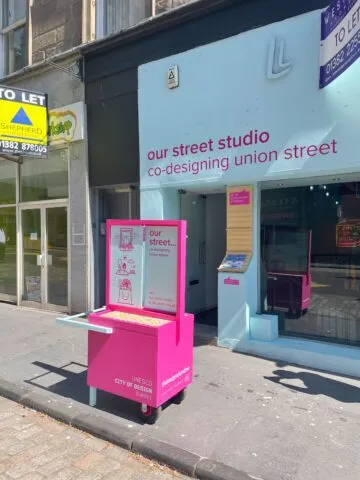
Co-design studio (Wallace, 2022)
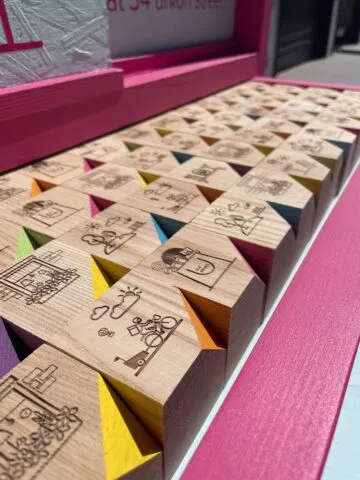
The Union Street project was a challenge for designers because typically the participants were a select group of people in other co-design projects. And on the public street, you don’t know who will go into the door and get involved. Linsey introduced a cart to us, which is quite interesting and show how they invite people in “our street studio”. Linsey and her colleague Gary went round with a cart to visit different stores and this cart has attracted the attention of local residents and tourists. Linsey said that they had all these little blocks made and call them the building blocks of the project. Each block has small icons that symbolize a different aspect of the street. Linsey said that the beautiful building block was like a memento and an invitation to engage with the project rather than a piece of paper.
In addition to the cart, she also introduced other different modules in the store that allow co-designers to participate. Think Tanks is one of the elements displayed on the wall, it allowed people to put their dream and share their vision for Union Street on a bubble. Linsey explained that “it was like it’s really an icebreaker task and to get people thinking big about the street”. We wanted to stimulate people with something that was really visual and hands on, to get them to touch and feel, not to give them a blank sheet.
There is another interesting element that allows non-designers to generate ideas quickly, called Community Collage. Some exciting example Other interesting cases around the world were posted on the wall which can inspire people to think and they can write down their thoughts on why they are drawn to these pictures. Linsey told us It’s just setting the tone for what we’re trying to do, not just telling them we’re going to do a specific design. She explained that if you are designer, you can very easy to generate some ideas from nothing but not everyone is like a designer who is exploring and discovering interesting things going on in other parts of the world every day. This gives me a thought that we can’t always think from the perspective of a designer, but need to think in an empathy way. This method shows how image board can help non-design to convey their idea effectively.
When ask about the benefit that non-designer bring into the process, she states that it is important to bring non-designer into the design process as they are experts in a certain field. People have been running their businesses on that street for over 20 years and they know how that street works. They can spot opportunities that we can’t. Linsey emphasized that they’re the experts here. Our projects don’t make sense if we don’t listen to the voices of the people who live or work here.
Union Street project demonstrates the practicality of co-design in the design process of public facilities. Co-design is also applied in various disciplines. Linsey McIntosh is the lecturer of Interior & Environmental design, and she also encourages her students to use this methodology of co-design in their own field because it has a positive effect on their career development. In an article written by Thamrin, Wardani, Sitindjak, and Natadjaja (2018) shows that fostering a deep connection and understanding of users can be learned through collective creativity and community collaboration. To counter the trend of contemporary designers being driven by profit, students should reflect on their role as interior designers, use multidisciplinary design innovation, and bring positive change to the community. We can see that the codesign method can play a practical role in interior design and enable student to gain an insight into users or stakeholders. According to Linsey, student should go out and engage with people and develop tools to engage with them. You can listen to them and write down their thoughts and being able to gather all the information. This skill can enhance students’ employability after they graduate.
Linsey went on to share with us a project with V&A and this kind of project genuinely shows the power that co-design brings to people. She worked on the V&A Dundee community project and the people she works with were seeking to improve their mental health and well-being. Co-design team said in an interview that it was quite a life changing for them. Another project that Linsey worked with palliative care patients at Roxburghe House. They design for wheelchair users who have trouble with building accessibility. Linsey said something that impressed me, she was told by the staff, the workshops have allowed patients to forget that they are ill for a period of time. I think in the process of cooperating with users, they not only feel valued but also participate in the whole design process. This design is truly made for them. This suddenly made me understand the meaning of the power of design or co-design. Terminology, User-centred design, we often see in books, but the story adds warmth to this word and allowed us to have a further understanding of the value of user engagement.
At the end of the interview, we critically asked about the drawback of co-design. She thinks there is no disadvantage to this method, but feels that it is a challenge for her. She said it is not an easy thing to do. I totally agree with her. Working with different people, who may have different personalities, different temperaments, different cultures, and different needs, as designers, we must be genuine with them and do our best.
Bibliography
Rossi, M., Meroni, A. and Selloni, D. (2018) Massive codesign: A proposal for a collaborative design framework. Milano, Italy: FrancoAngeli.
Wallace, K. (2022) Union street – our street studio, Design Dundee. Available at: https://cityofdesigndundee.com/union-street-community-co-design-project/ (Accessed: October 21, 2022).
Selloni, D. (2019) CODESIGN for public-interest services. SPRINGER.
Teal, G. et al. (2022) ‘Integrating and producing evidence through participatory design,’ CoDesign, pp. 1–18. Available at: https://doi.org/10.1080/15710882.2022.2096906.
Thamrin, D., Wardani, L. K., Sitindjak, R. H., & Natadjaja, L. (2018). ‘Experiential learning through community co‐design in Interior Design Pedagogy’. International Journal of Art & Design Education, 38(2), 461–477.
Keith, J. (2018) V&A Dundee helping palliative care patients to improve communal space design. Available at: https://www.thecourier.co.uk/fp/news/dundee/635331/va-dundee-help-palliative-care-patients-to-improve-communal-space-design/ (Accessed: October 21, 2022).
发表回复